
The three point bending flexural test is a crucial test in material science and engineering, often used to evaluate the strength, flexibility, and resistance of materials under bending stress. This test is particularly important in fields such as packaging, pharmaceuticals, and materials testing, where the durability and performance of materials like paperboard, plastics, and glass need to be assessed.
This article will explore the core principles of the three point bending flexural test, focusing on its applications in determining material strength, and how it integrates with ISO 9187 to ensure product integrity, particularly in the context of syringe testing.
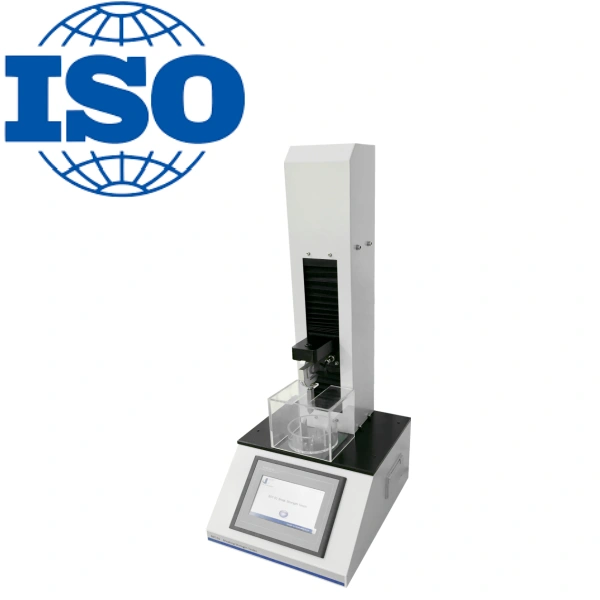
ISO 9187 Break Force Tester: An Essential Tool for Syringe Testing
ISO 9187 is a set of international standards that provides specifications for the testing of ampoules and syringes, particularly focusing on their breaking force. The break force tester, such as the glass ampoule break force tester, plays a key role in evaluating the resistance of syringes and ampoules under stress. These tests ensure that the syringes function properly and can withstand the pressures of medical use without failure.
For the three point bending flexural test, the methodology focuses on applying a force at the midpoint of a specimen supported at two other points. This testing method provides insight into the material’s performance when subjected to bending forces, which is similar to the forces applied in ISO 9187 tests for syringes.
How the Three Point Bending Flexural Test Works
The three point bending flexural test typically involves applying a force to the center of a material specimen, which is supported at both ends. The load is applied incrementally until the material fractures or deforms to a specific extent, and data is recorded regarding the force required for such deformation. This test is commonly used for materials like metals, plastics, and composites, but it also plays a crucial role in testing materials like cardboard or fiberboard used in packaging.
Flexural Strength and Modulus:
- The flexural strength is the material’s ability to withstand deformation when subjected to bending stress, while the flexural modulus measures the material’s stiffness under this load.
- In testing cardboard, for instance, the three point bending flexural test can determine how well the material will perform under conditions where it may be bent or compressed during use, such as in packaging.
Force Application: The force is applied at the midpoint of the specimen, and the deflection at the center is measured. The flexural strength is calculated from the maximum applied load before failure, and the deflection is observed to assess the material’s behavior under stress.
Connection to Syringe Testing: Understanding Break Force and Glide Resistance
In the context of syringe leak testing, the principles behind the three point bending flexural test share similarities with the forces required to operate the piston in syringes. Testing the force to operate the piston (also referred to as break loose force and glide force) ensures that the syringe performs reliably under real-world conditions.
ISO 9187-1 and ISO 9187-2 standards provide specific guidelines for testing the breaking force of syringes, including:
- The break force is determined by applying pressure to the syringe’s plunger until it is forced out of the body, similar to the bending stresses applied in flexural tests.
- The glide force determines the force required to maintain the movement of the piston once it has been initiated. This is important for ensuring that syringes operate smoothly and do not encounter excessive resistance during use.
Both tests focus on evaluating the resistance of a material or component under stress, and are essential for quality control in manufacturing processes.
Break Loose and Glide Force in Syringe Testing
In syringe testing, particularly for the glass ampoule break force tester, ISO 9187-2 outlines the procedures for determining how much force is needed to break the ampoule or syringe seal. This test measures the forces required to break the seals, ensuring that the device operates as expected under typical conditions.
Three Point Bending Flexural Test in Ampoule Testing:
- The ampoule bending tester is designed to apply bending stress to the ampoule and determine the force required to break the ampoule. This test is similar in nature to the three point bending flexural test, as it measures how materials respond to applied stress.
- Understanding the glide force of syringes and ampoules is crucial for ensuring that the devices do not experience excessive resistance, which could hinder the user’s ability to effectively use the product.
Conclusion
The three point bending flexural test is an essential tool for evaluating the strength and durability of materials under bending stress, with applications across many industries. In syringe testing, the forces required to operate the piston and the breaking force of the ampoule or syringe are critical factors in determining product quality. ISO 9187 provides clear standards for these tests, ensuring that syringes and ampoules perform reliably in medical and pharmaceutical applications.
By using advanced testing equipment like the Cell Instruments Ampoule Break Force Tester or Syringe Sliding Resistance Tester, manufacturers can ensure that their products meet the necessary standards for safety and performance. Whether for break loose and glide force testing or assessing flexural strength in packaging materials, these tests are essential for producing high-quality, reliable products.
 EN
EN  AR
AR  BG
BG  CS
CS  DA
DA  DE
DE  EL
EL  ES
ES  ET
ET  FI
FI  FR
FR  HU
HU  ID
ID  IT
IT  JA
JA  KO
KO  LT
LT  LV
LV  NB
NB  NL
NL  PL
PL  PT
PT  RO
RO  RU
RU  SK
SK  SL
SL  SV
SV  TR
TR  UK
UK  HE
HE  TH
TH  VI
VI