について Ampoule 3 Point Bend Test is a critical test used to assess the mechanical strength and durability of glass ampoules. This test is designed to measure the force required to break the ampoule under bending stress, simulating the mechanical forces that ampoules might face during transportation, handling, and storage. The test ensures that the ampoules can withstand external pressures without breaking prematurely.
In this article, we will explore the details of the Ampoule 3 Point Bend Test, its significance in ampoule breaking tests, and the standards that guide this process, including ISO 9187 break force testing. Additionally, we will highlight the glass ampoule break force tester and its role in achieving accurate results.

The Importance of the Ampoule 3 Point Bend Test
Glass ampoules are widely used in the pharmaceutical industry for packaging injectables, vaccines, and other sensitive products. Since these ampoules are made of glass, they must be tested for their ability to withstand forces that could cause them to crack or break. The Ampoule 3 Point Bend Test is essential in evaluating the strength of the glass and ensuring that the ampoule can endure external mechanical stress without failure.
This test applies a three-point bending force to the ampoule, simulating the conditions it might experience during handling, transportation, or storage. The force is applied at a specific point on the ampoule, and the test measures the amount of stress the ampoule can tolerate before it breaks.
The results of the Ampoule 3 Point Bend Test are used to evaluate whether the ampoules meet the required standards for strength and durability, ensuring that they are safe for use in the pharmaceutical industry.
Glass Ampoule Break Force Tester: How It Works
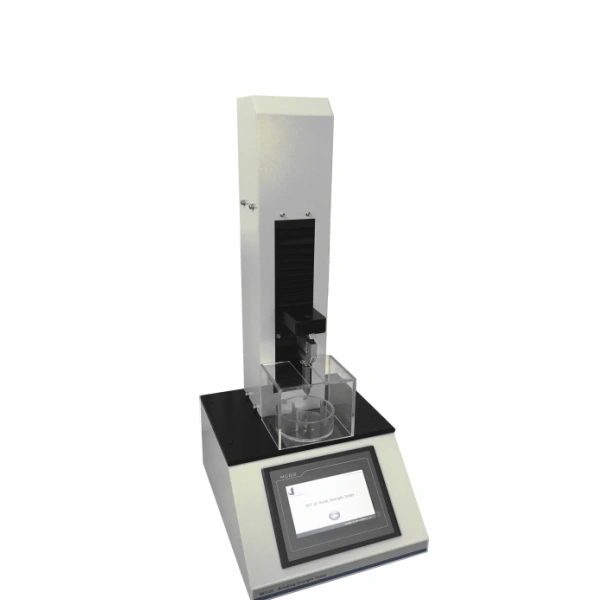
To perform the Ampoule 3 Point Bend Test, a glass ampoule break force tester is used. This specialized testing machine applies controlled force to the ampoule and measures the amount of pressure it can handle before breaking. The tester is equipped with a precise load cell to detect the force exerted on the ampoule, ensuring accurate and reproducible results.
ISO 9187-1:2010, which outlines the requirements for ampoules for injectables, specifies the standards for breaking force testing. According to this standard, the test should be conducted with a tensile testing machine capable of applying force at a consistent speed (10 mm/min) and measuring the force with an accuracy of ±1%. This ensures that the results are reliable and can be compared to the required specifications for ampoule strength.
について glass ampoule break force tester is calibrated to meet these standards and provides the necessary functionality to conduct the test in a controlled environment, giving manufacturers and quality control personnel the confidence that their ampoules meet the necessary safety requirements.
Ampoule Breaking: Key Considerations
Ampoule breaking is a crucial aspect of ampoule 3 point bend testing, as it directly affects the integrity of the ampoule and the product it contains. If an ampoule breaks prematurely, it can result in leakage, contamination, or exposure of the contents to external factors, compromising the quality and safety of the product inside.
To simulate real-world conditions, ISO 9187 specifies the procedure for testing the breaking force of ampoules. The testing machine must apply force to the ampoule until it ruptures, and the amount of force required to break the ampoule is recorded. The test is conducted under controlled conditions to ensure the results are accurate and consistent.
The ampoule should be tested at a temperature of 20°C ± 5°C to maintain consistency, and the breaking point should be positioned at the center of the ampoule. The breaking force should fall within the range specified by the standard to ensure the ampoule is strong enough to withstand normal handling conditions.
ISO 9187 Break Force Testing: Standards for Ampoule Testing
ISO 9187 outlines the requirements for testing ampoules used for medical purposes. This standard provides guidelines for hydrolytic resistance, annealing qualityそして 破壊力. Specifically, ISO 9187-1 defines the procedure for determining the 破壊力 required to separate the ampoule stem from the body. The test helps manufacturers ensure that their ampoules can endure normal handling without breaking or cracking.
によると ISO 9187-1, the ampoules should have a predetermined breaking point, such as a ceramic ring, at the constriction to facilitate a clean break. The ISO 9187-2 section further outlines the requirements for the breaking point’s position and stability, emphasizing that the maximum deviation from the centerline should not exceed +1 mm.
By adhering to these standards, manufacturers can ensure that their ampoules meet the necessary quality requirements for medical use.
The Role of Ampoule 3 Point Bend Testing in Quality Control
について Ampoule 3 Point Bend Test is a vital procedure for evaluating the strength and integrity of glass ampoules. By measuring the force required to break the ampoule under bending stress, manufacturers can determine if their ampoules meet the required standards for safety and durability.
Using a glass ampoule break force tester in accordance with ISO 9187 ensures that the test is conducted with precision and accuracy. This test helps manufacturers ensure that their ampoules will withstand handling, transportation, and storage without compromising the quality of the product inside.
For manufacturers looking to maintain the highest standards of quality control, セルインスツルメンツ offers advanced testing equipment, including the glass ampoule break force tester. These tools provide reliable and reproducible results, ensuring that your ampoules meet the necessary strength requirements for safe use in the pharmaceutical industry.