
What Is Ampoule Hydrolytic Resistance Testing?
Ampoule Hydrolytic Resistance Testing is a chemical durability test used to evaluate the resistance of ampoule glass to water attack. Unlike mechanical tests that measure breaking force, top load, or impact resistance, hydrolytic resistance testing focuses on how readily glass releases soluble components when exposed to water under controlled conditions. For pharmaceutical ampoules, this property is particularly important because the glass container comes into direct contact with the drug formulation. If the glass has insufficient hydrolytic resistance, water can promote the release of alkaline or other soluble components, potentially affecting drug stability and container-drug compatibility. ISO 719 и ISO 720 specify hydrolytic resistance testing methods for glass grains, while USP 660 и EP 3.2.1 provide requirements for pharmaceutical glass containers.
The test typically uses glass grains prepared from the ampoule rather than testing the complete container directly. The prepared particles are exposed to water under specified conditions, and the resulting extract is evaluated to determine the hydrolytic resistance of the glass. ISO 719 applies to testing at 98 °C, while ISO 720 applies to testing at 121 °C. Therefore, Glass Ampoule Hydrolytic Resistance testing provides a practical way to evaluate the chemical durability of pharmaceutical glass and verify its suitability for contact with drug formulations.
Why Is Hydrolytic Resistance Important for Ampoule Glass?
Ampoules are widely used for injectable and other pharmaceutical products because glass provides excellent barrier properties and chemical stability. However, different glass compositions do not have identical resistance to water attack.
During long-term contact with aqueous formulations, components within the glass may gradually migrate into the product. The extent of this interaction depends on factors such as glass composition, manufacturing conditions, surface condition, temperature, and exposure time.
Hydrolytic resistance testing helps manufacturers and laboratories:
- Evaluate the chemical durability of ampoule glass.
- Compare different glass compositions or suppliers.
- Support container-drug compatibility evaluation.
- Monitor consistency between production batches.
- Identify changes in glass quality during manufacturing.
- Support pharmaceutical packaging quality control.
- Demonstrate compliance with applicable standards and pharmacopeial requirements.
For pharmaceutical manufacturers, the objective is not simply to determine whether a glass ampoule is physically strong. The glass must also provide appropriate chemical resistance throughout the intended product shelf life.
Principle of the Glass Grain Hydrolytic Resistance Test
Сайт hydrolytic test for glass is based on the interaction between glass and water under controlled conditions.
For the glass grain method, an ampoule or representative glass sample is first converted into particles within the specified size range. The prepared grains provide a controlled glass surface area for the test. The sample is then subjected to water treatment according to the applicable method.
During exposure, soluble components can migrate from the glass into the water. The resulting extract provides an indication of the glass’s resistance to hydrolytic attack.
The general principle can be summarized as:
Ampoule glass → controlled glass grain preparation → water treatment → extraction → evaluation of hydrolytic resistance
The test conditions depend on the applicable standard. ISO 719 and ISO 720, for example, specify different temperature conditions for glass grain hydrolytic resistance testing.
Because particle size and sample preparation can influence the exposed glass surface, consistent glass grain preparation is an important part of obtaining repeatable results.
How Is Ampoule Hydrolytic Resistance Testing Performed?
A typical hydrolytic resistance test for glass containers involves several controlled stages.
1. Select the Ampoule Glass Sample
Representative ampoules are selected from a production batch, development sample, or incoming material lot. The sample should represent the glass container being evaluated.
2. Prepare Glass Grains
The ampoule glass is broken and crushed into grains using appropriate equipment. The grains are then separated by sieving to obtain the particle-size fraction required by the applicable procedure.
Сайт GHR-01A Glass Grain Hydrolytic Resistance Sampler is designed for this preparation stage. It integrates crushing, vibratory sieving, and collection to reduce manual handling and improve repeatability.
3. Perform the Hydrolytic Treatment
The prepared glass grains undergo controlled exposure to water according to the selected test method. Temperature, time, sample quantity, and other test conditions need to remain consistent.
4. Evaluate the Extract
After treatment, the resulting solution is evaluated to determine the amount of soluble material released from the glass. The result is then used to classify or assess the hydrolytic resistance of the glass according to the applicable standard.
5. Compare With Requirements
The final result can be compared with the requirements applicable to the pharmaceutical glass container, formulation, or regulatory market.
This procedure demonstrates why the hydrolytic resistance test for glass requires controlled sample preparation as well as controlled testing conditions.
Glass Grain Preparation for Hydrolytic Resistance Testing
Although glass grain preparation is not the final test itself, it directly supports the reliability of the hydrolytic resistance evaluation.
The GHR-01A combines an integrated mortar and pestle with a vibratory sieve system. Its purpose is to produce and classify glass grains before they enter the hydrolytic resistance procedure.
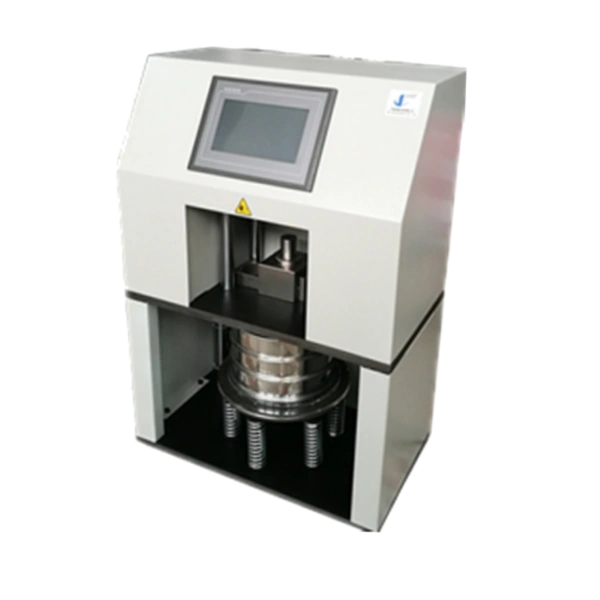
GHR-01 Technical Specifications
| Параметр | Технические характеристики |
|---|---|
| Mortar/Pestle Dimension | Φ50 / Φ48 mm |
| Sieve A Aperture | 425 μm |
| Sieve B Aperture | 300 μm |
| Sieve O Aperture | 600 μm |
| Sieve Shaking Duration | 5 min |
| Gas Pressure | 0.5 MPa |
| Gas Port Size | Φ6 mm |
| Мощность | 110–220 В переменного тока, 50/60 Гц |
The automated crushing and sieving process helps minimize unnecessary operator contact with broken glass while maintaining a more consistent particle-size distribution.
Key Benefits of Automated Glass Grain Preparation
For laboratories performing routine Ampoule Hydrolytic Resistance Testing, automated preparation can provide several practical advantages.
| Feature | Benefit |
|---|---|
| Integrated crushing and sieving | Simplifies the sample preparation workflow |
| Standard-conformed mortar and pestle | Supports consistent glass crushing |
| Automated operation | Reduces manual intervention |
| Precision vibratory sieving | Helps obtain the required grain fraction |
| HMI touch screen | Simplifies parameter setting and operation |
| Safety mechanisms | Reduces direct contact with broken glass |
| Repeatable preparation | Supports consistent testing between samples |
The main value of the GHR-01A is therefore not to replace the hydrolytic resistance test, but to provide a more controlled and repeatable method for preparing the glass grains required by the test.
Standards Related to Ampoule Glass Grain Preparation
Several international and pharmacopeial standards may be relevant depending on the glass type and intended application.
| Стандарт | Main Application |
|---|---|
| ISO 719 | Hydrolytic resistance of glass grains at 98 °C |
| ISO 720 | Hydrolytic resistance of glass grains at 121 °C |
| USP 660 | Containers—Glass |
| EP 3.2.1 | Glass containers for pharmaceutical use |
ISO 719 and ISO 720 are particularly relevant to glass grain hydrolytic resistance evaluation. USP 660 and EP 3.2.1 provide broader requirements and considerations for pharmaceutical glass containers.
The applicable standard should be selected according to the glass container type, pharmaceutical application, and regulatory requirements of the target market.
What Do Hydrolytic Resistance Results Tell You?
The result of a hydrolytic resistance test provides information about the chemical durability of the glass.
A glass with stronger hydrolytic resistance generally releases fewer soluble components under the specified test conditions. This makes the result useful when evaluating whether a glass container is appropriate for its intended pharmaceutical application.
Laboratories can use the results to:
- Compare glass materials from different suppliers.
- Verify the consistency of production batches.
- Support pharmaceutical packaging development.
- Investigate changes in container quality.
- Evaluate container-drug compatibility.
- Support regulatory and quality documentation.
However, hydrolytic resistance should be considered together with other important container properties. A glass ampoule may have appropriate chemical durability while still requiring evaluation of mechanical strength, dimensional accuracy, sealing performance, and opening performance.
Other Tests for Glass Ampoules
For a complete evaluation of ampoule quality, laboratories may combine hydrolytic resistance testing with mechanical and dimensional tests.
| Test | Purpose |
|---|---|
| Ampoule Breaking Force Test | Determines the force required to break or open the ampoule |
| Ampoule Leakage Test | Evaluates container sealing and leakage performance |
| Ampoule Axial Deviation Test | Measures axial alignment and dimensional deviation |
| Ampoule Wall Thickness Test | Evaluates glass wall and bottom thickness |
| Ampoule Top Load Test | Measures resistance to compressive loading at the ampoule top |
These tests address different quality characteristics. Hydrolytic resistance evaluates chemical durability, while breaking force, leakage, thickness, axial deviation, and top load evaluate mechanical, dimensional, or functional performance.
Заключение
Ampoule Hydrolytic Resistance Testing is an important evaluation of the chemical durability of glass used for pharmaceutical ampoules. By measuring the glass’s resistance to water-induced release of soluble components, the test provides valuable information about glass quality, container-drug compatibility, and pharmaceutical packaging performance. In the glass grain method, consistent sample preparation is essential because particle size and sample handling can influence test repeatability. The GHR-01A Glass Grain Hydrolytic Resistance Sampler integrates controlled crushing, sieving, and collection into one workflow, helping laboratories prepare consistent glass grain samples for hydrolytic resistance evaluation. Combined with applicable standards such as ISO 719, ISO 720, USP 660, and EP 3.2.1, hydrolytic resistance evaluation can form an important part of a comprehensive quality-control program for pharmaceutical glass ampoules and other glass containers.
Reliable Ampoule Hydrolytic Resistance Testing requires both controlled test conditions and consistent glass grain preparation. Cell Instruments provides the GHR-01A Glass Grain Hydrolytic Resistance Sampler to streamline crushing, sieving, and collection for pharmaceutical glass testing. We also provide customized fixtures and testing solutions for ampoules, vials, and other pharmaceutical packaging. Contact Клеточные инструменты to discuss your testing requirements, obtain technical specifications, or request a quotation for a suitable glass container testing solution.
 EN
EN  AR
AR  BG
BG  CS
CS  DA
DA  DE
DE  EL
EL  ES
ES  ET
ET  FI
FI  FR
FR  HU
HU  ID
ID  IT
IT  JA
JA  KO
KO  LT
LT  LV
LV  NB
NB  NL
NL  PL
PL  PT
PT  RO
RO  RU
RU  SK
SK  SL
SL  SV
SV  TR
TR  UK
UK  HE
HE  TH
TH  VI
VI